
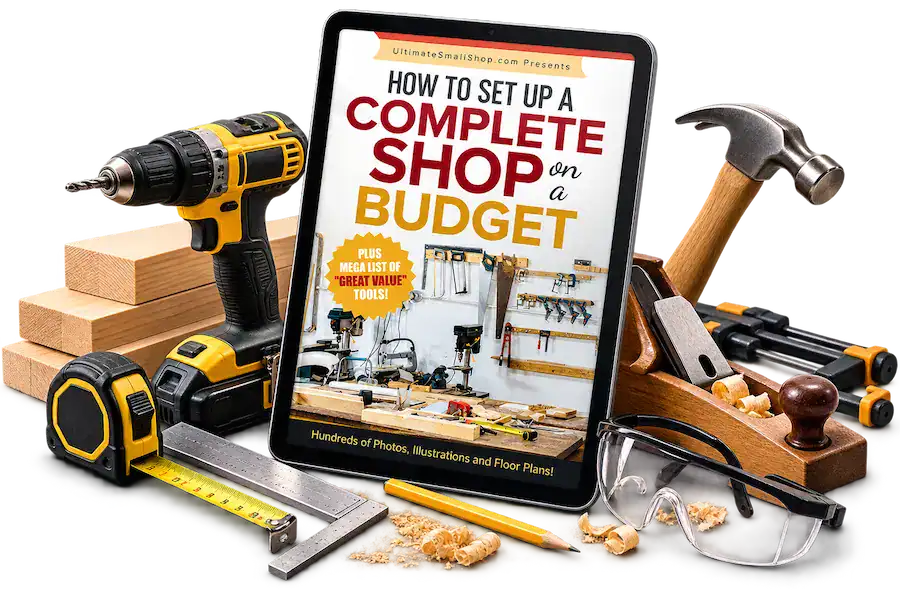
The Ultimate Small Shop Guide Review
Setting up a woodworking shop can quickly become expensive. Power tools, hand tools, storage, dust control, lighting, and workspace improvements all add to the initial investment. Space can be just as challenging, especially for woodworkers using a garage, basement, shed, or spare room.
The Ultimate Small Shop Guide approaches these problems from a practical angle: how to set up a complete shop on a budget while making effective use of limited space.
Created by Ralph Chapman, the digital guide focuses on selecting tools, planning the workspace, finding better prices, improving shop organization, and addressing practical considerations such as lighting, ventilation, heating, storage, and safety.
In this The Ultimate Small Shop Guide review, we’ll examine what the program contains, its potential advantages and limitations, its current price and bonuses, the refund policy, and the independent customer feedback available online.
What Is The Ultimate Small Shop Guide?
The Ultimate Small Shop Guide is a 246-page illustrated digital woodworking guide organized into six modules covering the major considerations involved in creating a home workshop.
Rather than teaching individual woodworking projects, its primary purpose is helping readers create the environment in which those projects can be built.
The official presentation places particular emphasis on two problems: choosing appropriate tools without overspending and creating a functional workshop when available space is limited.
According to the publisher, the recommendations are based on Ralph Chapman’s decades of woodworking experience and lessons learned from purchasing, testing, and replacing different tools.
The guide is therefore better understood as a workshop planning and purchasing resource than as a conventional woodworking course.
What Does the Guide Cover?
The six modules address different stages of creating and operating a home woodworking shop.
Module 1: Tool Selection
The first module helps readers decide which tools they actually need before making purchases.
It includes separate shopping recommendations for people working with a hand-tool budget under $500 and those planning a combination of hand and power tools with a budget under $1,000.
The module also discusses stationary, portable, and pneumatic tools and provides recommendations concerning where certain tools can be purchased.
One of the product’s most heavily promoted features is access to alternative suppliers that the creator says can offer substantial savings compared with major retailers.
Because prices and inventory change over time, shoppers should verify current prices independently before making purchasing decisions.
Module 2: Space Selection
A woodworking shop does not necessarily require a large dedicated building.
The guide discusses how to evaluate potential workshop locations and the practical limitations of different spaces.
This can be particularly relevant to woodworkers considering a garage, basement, shed, or another relatively small area of their home.
The publisher claims that a functional shop can be established in an area as small as approximately 10 by 6 feet, although the practicality of any layout naturally depends on the equipment and projects involved.
Module 3: Shop Layouts
Once a location has been selected, workflow and equipment placement become important.
This part of the guide provides workshop layout ideas intended to make better use of available floor space and improve movement between tools and work areas.
For someone building a first workshop, having example layouts can make the planning process considerably easier than positioning each machine independently and reorganizing everything later.
Module 4: Electricity and Lighting
Woodworking equipment can place significant demands on a home’s electrical system.
The guide discusses electrical considerations and lighting as part of workshop planning.
Electrical modifications should always be approached carefully. Any installation or circuit changes that require professional electrical work should be handled by a qualified electrician and comply with applicable local codes.
Module 5: Heating, Cooling, Ventilation and Dust
Comfort is only part of environmental control in a workshop.
Dust collection, airflow, temperature, humidity, and ventilation can affect both the working environment and stored materials.
The guide discusses ventilation strategies, shop vac recommendations, heating options, and temperature and humidity considerations for woodworking spaces.
Module 6: Workshop Safety
The final module focuses on creating safer working conditions.
Topics include cable management, fire prevention, workshop organization, and a ten-item shop safety checklist.
No woodworking guide can eliminate the inherent risks associated with power tools and machinery. Manufacturer instructions, appropriate personal protective equipment, safe operating practices, and applicable electrical and fire-safety requirements should always take priority.
What Makes The Ultimate Small Shop Guide Different?
The central idea behind the program is not simply building a smaller workshop. It is combining space efficiency with controlled spending.
Many woodworking resources concentrate on projects or techniques after a workshop already exists. The Ultimate Small Shop Guide instead concentrates primarily on the decisions that come before that stage.
That includes questions such as:
- Which tools are actually necessary?
- How much should you spend?
- Which equipment can you postpone purchasing?
- Where should machines and work surfaces be positioned?
- How can a limited space remain functional?
- Where might tools and materials be purchased for less?
For someone starting from scratch, these decisions can represent a substantial part of the challenge.
The Under-$1,000 Workshop Claim
A major part of the sales presentation is the claim that readers can create a functional woodworking shop for less than $1,000.
This should be viewed as a publisher claim rather than a guaranteed budget.
Actual setup costs can vary substantially according to the tools someone already owns, local prices, shipping, workshop condition, electrical requirements, chosen equipment, and the types of woodworking projects they intend to undertake.
Nevertheless, the broader strategy of establishing a budget before purchasing equipment and distinguishing essential tools from optional ones is sensible.
The guide also includes recommendations for people with less than $500 available who prefer to begin primarily with hand tools.
Potential Advantages
Focuses on Two Common Beginner Problems
Tool selection and workshop space are legitimate obstacles for new woodworkers.
Buying too much equipment can waste money and consume valuable floor space, while buying tools primarily because they are inexpensive can create other problems.
The guide attempts to provide a structured middle ground.
Designed Around Small Spaces
The emphasis on compact workshops makes the material particularly relevant to people without access to a large dedicated building.
Garages, basements, sheds, and similar spaces often require considerably more planning than large professional workshops.
Budget-Conscious Approach
Cost management runs throughout the program.
Instead of assuming that every woodworking machine is essential, the guide encourages readers to determine which tools correspond to the work they actually intend to perform.
Combines Planning With Buying Guidance
The guide goes beyond room layouts by combining workspace planning with tool recommendations, purchasing resources, environmental considerations, and safety.
This makes it a more comprehensive workshop-setup resource than a simple collection of floor plans.
Instant Digital Access
The main product is digital, so buyers can access and download the material immediately after their purchase is processed.
The official offer also states that buyers can access an option related to having the materials shipped through the members area. Any physical delivery options and associated costs should be confirmed there before ordering.
What Could Be Better?
The guide has some limitations worth considering before purchasing.
It Is Not a Woodworking Project Course
Someone looking primarily for furniture plans, joinery lessons, project videos, or detailed woodworking technique instruction may find another type of program more appropriate.
The Ultimate Small Shop Guide concentrates on establishing the workshop itself.
Tool Recommendations Can Age
Specific tool models, prices, retailers, and supplier deals naturally change.
This is particularly important for a guide in which purchasing recommendations represent a significant part of the value proposition.
Readers should compare current market prices and availability rather than assuming that every historical example or discount remains available.
Some Information Can Be Researched Independently
Topics such as shop organization, lighting, dust collection, ventilation, and basic tool selection are widely discussed online.
The value proposition therefore depends partly on whether you prefer having the information organized into a structured system instead of researching each topic separately.
The Sales Page Uses Aggressive Marketing Language
The official presentation makes strong claims regarding potential tool discounts and workshop setup costs.
These claims should not replace independent price comparisons. The actual savings available to an individual buyer will depend on current products, suppliers, location, shipping, and purchasing decisions.
The Ultimate Small Shop Guide Packages & Pricing
The current official offer is straightforward because there is one primary package.
| Package | Format | Price | Delivery | Shipping | Extras / Bonuses |
|---|---|---|---|---|---|
| The Ultimate Small Shop Guide | Digital guide | $29 | Instant digital access | Not required for digital download | The Workshop Cheat List + Deal Alert Service |
The sales page currently displays a regular retail reference price of $79 and an offer price of $29.
Because the publisher describes the $29 price as a promotional offer that may change, prospective buyers should verify the final checkout price before completing their order.
What Is Included for $29?
The current offer includes:
- The 246-page illustrated Ultimate Small Shop Guide
- Six workshop-setup modules
- Tool selection guidance
- Tool price guides
- Supplier resources
- Workshop layout examples
- The Workshop Cheat List
- Deal Alert Service
- Instant digital access
Bonus #1: The Workshop Cheat List
The Workshop Cheat List focuses on reducing the cost of tools, lumber, and workshop supplies.
It supplements the main guide’s cost-saving approach with additional sourcing and purchasing strategies.
Bonus #2: Deal Alert Service
The Deal Alert Service is designed to provide alerts about discounted deals available online.
The practical value of this bonus will naturally depend on the availability and relevance of deals when the service is used.
Is There a Subscription?
The main $29 Ultimate Small Shop Guide offer is presented as a purchase rather than a recurring subscription.
However, customers should always review the checkout page carefully before completing an online purchase, particularly if additional products or optional offers are presented during checkout or afterward.
60-Day Money-Back Guarantee
The Ultimate Small Shop Guide comes with a 60-day money-back guarantee.
The official Terms and Conditions state that customers can receive a full refund of the purchase price within 60 days of delivery if they are dissatisfied for any reason.
The sales page similarly describes the offer as a 100% money-back guarantee and states that customers can request a refund within the 60-day period if they are not satisfied.
This gives buyers time to examine the guide and decide whether its recommendations provide enough practical value for their workshop plans.
Who Is The Ultimate Small Shop Guide Best For?
The program may be particularly useful for:
- Beginner and hobbyist woodworkers
- People creating their first woodworking workshop
- Woodworkers with limited garage or basement space
- DIY enthusiasts trying to control initial equipment costs
- People uncertain about which woodworking tools they actually need
- Woodworkers who prefer an organized workshop-planning resource rather than researching each topic separately
It may be less appropriate for experienced woodworkers who already have a fully equipped and efficiently organized shop or anyone primarily seeking woodworking projects and technique instruction.
The Ultimate Small Shop Guide Pros and Cons
Pros
- One-time $29 current offer price
- 246-page illustrated digital guide
- Six workshop-planning modules
- Strong emphasis on budget-conscious setup
- Useful focus on limited workshop space
- Tool selection and purchasing guidance
- Workshop layout recommendations
- Covers ventilation, lighting, environmental considerations, and safety
- Instant digital access
- Includes two current bonuses
- 60-day money-back guarantee
Cons
- Primarily a workshop setup guide rather than a woodworking project course
- Specific tool and pricing recommendations may become outdated
- Some general workshop information can also be researched independently online
- Actual workshop costs will vary and may exceed the advertised under-$1,000 target
- Strong savings claims on the sales page should be independently verified
- Independent customer feedback is available but remains relatively limited compared with mainstream woodworking books and courses
What Do Independent Reviews Say?
Independent feedback is somewhat mixed, which is useful when evaluating the promotional claims made on the official sales page.
Goodreads lists Ultimate Small Shop by Ralph Chapman with a 4.35/5 average from 40 ratings at the time of our research.
Several reviewers specifically mention the budgeting advice, small-space recommendations, tool guidance, and organization of the material as positives.
However, the feedback is not universally favorable. One Goodreads reviewer considered the PDF too limited for the price, while another positive reviewer noted that some product recommendations appeared outdated or focused on particular brands.
This distinction matters because part of the guide’s usefulness depends on tool and supplier information that can change over time.
The Better Business Bureau also maintains a business profile for Ultimate Small Shop. At the time of our research, the business was not BBB accredited and was not rated, with the BBB stating that it did not have sufficient information to issue a rating.
The profile also contains a customer complaint about not receiving access information and being unable to obtain a response from support.
A BBB listing, accreditation status, or individual complaint does not by itself establish the overall quality of a product. However, prospective buyers should consider both positive and negative independent feedback alongside the publisher’s own testimonials.
Is The Ultimate Small Shop Guide Worth It?
At the current $29 price, the strongest argument for the Ultimate Small Shop Guide is convenience.
Most individual subjects covered by the guide can be researched separately. What the product offers instead is a structured roadmap that brings workshop planning, tool selection, layouts, purchasing strategies, environmental considerations, and safety into one resource.
That can be useful for a beginner who does not yet know what questions need to be answered before building a workshop.
The 60-day refund period also reduces the financial commitment required to evaluate the material.
The more ambitious marketing claims deserve greater caution. A complete workshop under $1,000 may be achievable under certain circumstances, but it should not be treated as a universal outcome. Likewise, advertised tool discounts should be compared against current market prices.
Final Verdict
The Ultimate Small Shop Guide is best viewed as a practical workshop-planning resource for beginner and hobbyist woodworkers who have more ambition than available space or budget.
Its strongest feature is the breadth of the setup process it attempts to organize. Instead of concentrating solely on buying tools, it addresses tool selection, space, layout, electrical considerations, lighting, ventilation, temperature, dust management, organization, and safety.
At the current $29 price, the package also includes The Workshop Cheat List and Deal Alert Service, while the 60-day money-back policy provides an opportunity to evaluate the material.
Experienced woodworkers with established shops may find much of the fundamental material familiar. Likewise, readers primarily interested in project plans or woodworking techniques should recognize that this is not the main purpose of the program.
For someone starting a home workshop from scratch, however, having a structured plan could help avoid unnecessary purchases and layout mistakes before they happen.
The key is to treat specific savings and under-$1,000 setup figures as goals or publisher claims rather than guaranteed outcomes—and verify current tool prices independently before purchasing equipment.
Frequently Asked Questions
The Ultimate Small Shop Guide is a 246-page illustrated digital resource by Ralph Chapman designed to help woodworkers plan and set up a functional home workshop while controlling costs and making efficient use of limited space.
The official sales page currently lists The Ultimate Small Shop Guide for $29, reduced from a displayed retail reference price of $79. The publisher describes this as a promotional price, so the final checkout price should be verified before purchasing.
The primary product is a digital guide with instant access after purchase. The official sales page also mentions an option in the members area related to having the materials shipped. Buyers interested in physical delivery should check the current options and any associated shipping charges after purchase.
The guide covers tool selection, workshop space, shop layouts, electricity and lighting, environmental considerations such as heating, cooling and ventilation, and workshop safety.
Yes. The current $29 offer includes two advertised bonuses: The Workshop Cheat List and Deal Alert Service.
The publisher states that the guide is designed to help readers establish a functional workshop for under $1,000. Actual costs depend on existing equipment, tool choices, local prices, shipping, electrical requirements, workshop condition, and other individual circumstances, so this figure should not be considered guaranteed.
Yes. The official Terms and Conditions provide a full refund of the purchase price within 60 days of delivery if the customer is not satisfied for any reason.
Beginners are one of the clearest audiences for the program because it concentrates on decisions that need to be made before a workshop is fully established, including tool selection, budgeting, workspace planning, layout, and safety.
Sources & References
Official Product Sources
The Ultimate Small Shop Guide – Official Sales Page
https://ultimatesmallshop.com/offer/?hopId=60377f53-4aab-48d5-922d-caeae9b8075e&&shield=a7656n1n1mwa084rybibnfslwn
Ultimate Small Shop – Terms, Conditions and Refund Policy
https://ultimatesmallshop.com/terms/?hopId=60377f53-4aab-48d5-922d-caeae9b8075e
Independent Sources
Goodreads – Ultimate Small Shop by Ralph Chapman
https://www.goodreads.com/book/show/45166204-ultimate-small-shop
Better Business Bureau – Ultimate Small Shop Business Profile
https://www.bbb.org/us/il/chicago/profile/woodworking/ultimate-small-shop-0654-90024283